Your Baldwin County hurricane checklist has four parts. Add whole-home surge protection and a properly wired generator before June. When a storm gets a name, kill sensitive circuits and unplug electronics. Never backfeed a portable through a dryer outlet. And once the water goes down, leave the main off until a licensed electrician has looked at anything that got wet.
Jimmy has worked storm calls in Baldwin County since 2015. Almost everything that goes sideways after a hurricane down here is preventable with a few dry-weather decisions.
What Sally still teaches this coast
Sally is the reference storm on this stretch of shore. She came ashore at Gulf Shores at 5 a.m. on September 16, 2020, Category 2, 105 mph sustained. A 123 mph gust hit Perdido Pass. Rain gauges at Orange Beach caught 29.99 inches, which is a hurricane’s worth of water in one storm.
Baldwin EMC lost roughly 78,000 meters at the peak. It took the co-op ten days of round-the-clock work with more than a thousand linemen on the ground to bring the last serviceable meter back online.
Baldwin EMC restoration updates, September 2020
See the numbers
| Date | Members without power | Note |
|---|---|---|
| Sep 16 | 78,146 | Peak, 78,146 out |
| Sep 21 | 29,307 | About 61% restored |
| Sep 24 | 1,872 | ~95% restored |
| Sep 26 | 0 | 100% of serviceable meters back |
Days, not hours.
Ivan in 2004 was worse, and older neighbors still measure storms against it. Alabama Power alone logged 825,000 outages that September, the most in the utility’s history, and parts of Baldwin County stayed dark for weeks. The dry-weather work in the rest of this checklist is written for a coastline where that is a live possibility every June through November.
The three jobs to finish before June
Once a system enters the Gulf, the phones ring nonstop, generator inventory dries up, and lead times on transfer switches stretch out to weeks. Three jobs matter before hurricane season starts, and they matter in this order.
1. A whole-home surge protector at the panel
Baldwin County sits right on the shoulder of the state’s lightning capital. Vaisala’s 2022 report named Mobile, just across the bay, the highest-density lightning zone in Alabama at 225 strikes per square kilometer over five years. A hit two blocks over on the same distribution line can push a surge through every service drop in the neighborhood in a fraction of a second.
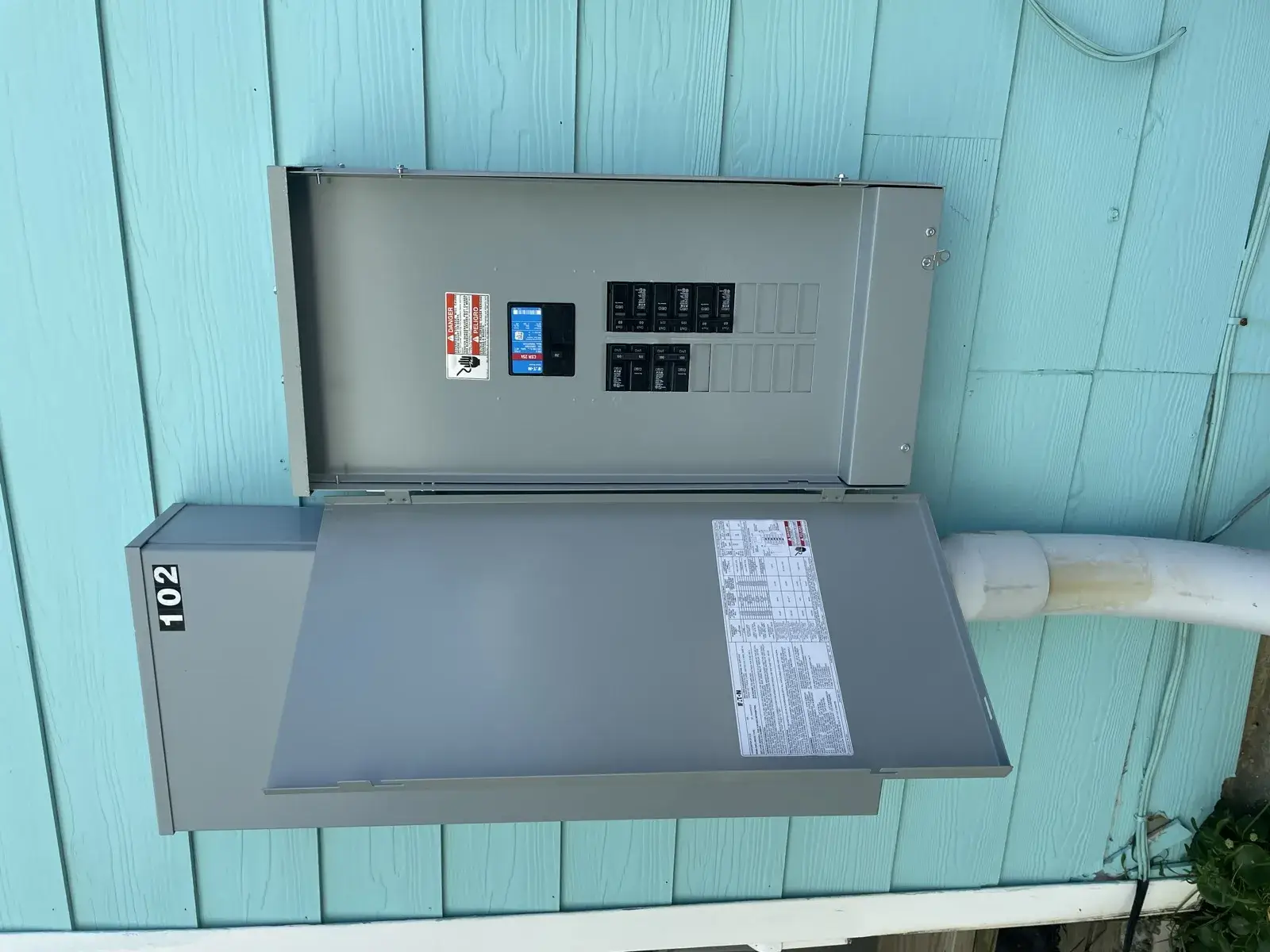
Panel-level surge protection mounts inside your electrical panel on its own breaker and clamps that spike before it reaches anything downstream. It covers the HVAC control board, the fridge, the well pump, and every outlet in the house at once. Power strips only protect what is plugged into them. A whole-home surge protector sized to your service is a couple of hours of work on a dry Tuesday, and it is the cheapest single upgrade on this list.
2. A permanent way to run a generator
If you rode out the last storm with cords through a cracked window, this is the year to fix that. A generator wired to a transfer switch or an interlock is the difference between a working fridge, a running AC, a functioning well pump, and four days of takeout food and cold showers.
Two paths. A portable paired with an interlock kit on your existing panel is the budget option, and it is where most Baldwin County homeowners land. A whole-home standby on a pad wired to an automatic transfer switch is the option for people who travel, run medical equipment at home, or just do not want to think about it during the next storm. We walk the tradeoffs in whole-home vs portable generator on the Gulf Coast.
If you are a Baldwin EMC member, the co-op also markets a GenerLink meter-socket interconnect that auto-disconnects from the grid to prevent backfeed. It is worth a call before you buy the interlock hardware.
Whichever path you pick, the tie-in needs a permit. Your city issues it, or the county if you are unincorporated, and no utility here signs off on the connection without the permit on file. Our Baldwin County electrical permits guide walks who and how by town.
3. Walk the outside of the house
Look at the meter base, the service mast, the weatherhead, and the point where the drop hits the wall. Rust running down the meter can. A hairline crack around the mast collar. A loose connector at the weatherhead. Those are April fixes, not October ones, and they cost a fraction in dry weather what they cost after a storm.
Take a phone photo of everything while it is still standing. If the storm changes what any of it looks like, that photo is what an adjuster uses to prove what was there before.
When a storm gets a cone
Once the National Hurricane Center draws a cone across the Gulf, the clock is running. The 48 to 72 hours before landfall is where the small decisions add up.
Should I turn off my main breaker before a storm?
Usually no, not the main. Kill the individual breakers for the sensitive stuff, the HVAC, the well pump, the garage door opener, the office, and unplug the electronics you are not using. The main only comes off in two situations. You are running a generator once the utility drops, or floodwater is about to reach an outlet.
What kills equipment in a storm is not the wind sitting overhead. It is the surge that rides in on the service when a line falls or a transformer blows. Killing the big motor loads means the AC compressor and the well pump are not caught mid-cycle when power blips off and stutters back on twelve seconds later, which is exactly where control boards get cooked.
One exception, and it applies to low-lying property in Gulf Shores, Orange Beach, and anywhere the tide can reach a crawlspace. Kill the main before water reaches the outlets. Energized wiring in floodwater is what starts fires and hurts people.
The night-before walkthrough
Before the storm
Print this, put it with the flashlights, run through it every June and every September.
Running a generator without killing a lineman
A generator either runs into an interlock or a transfer switch, or it runs on standalone extension cords to individual appliances. Nothing in between is legal. Nothing in between is safe.
Here is what actually happens when you backfeed. Two hundred and forty volts push back through your panel, up the service drop, and into the transformer on the pole, which steps it back up to distribution voltage. That is what electrocutes the crew climbing the pole to reconnect your street. Not theory. It has killed linemen in Alabama.
If the power is already out and you have not had an interlock installed yet, run cords straight from the generator to the fridge, a lamp, a fan, and a charging strip. That is fine. Anything else waits until the utility is back.
Where to put the generator
Twenty feet minimum from any window, door, or vent, with the exhaust pointed away from the house. On a dry surface, under a canopy or a storm-rated tent. Never in the garage, never on a covered porch, and refueled outside once it cools.
Carbon monoxide from a generator running too close is the second biggest storm hazard on the Gulf Coast after downed lines. It kills people every hurricane season and it is entirely preventable.
After the storm, before you flip the main
The storm passing is when the phone starts. Half of those calls could wait a day. The other half absolutely cannot.
Flooded panels get replaced, not dried
A panel that took on water is replaced. Not dried, not blown out with compressed air, not left overnight in the sun to see what happens. Once salt water and mud get inside a panel or a receptacle, the corrosion keeps working long after the visible water is gone. The failure shows up weeks later as an arc fault or a shorted breaker on the hottest day of August, right when you need the AC to run.
Same rule for outlets on exterior walls, in garages, or below the high-water line. Grit in the slot. Brown or black discoloration around the receptacle. Water stains on the plate. All replacements. A damaged outlet can read normal on a plug-in tester and still fail once it carries a real load, which is why testing does not clear a flood-exposed circuit.
Who fixes the meter base, you or the power company?
You do, through a licensed electrician. The utility owns the wire up to the meter. Everything from the meter into the house is yours, and if the storm tore your mast off the wall the line crew looks at it, notes the address, and drives to the next house because there is nothing they can legally reconnect to. That surprises people, especially at 7 a.m. after a bad night.
Wave Electric handles storm meter-base and service-entrance repairs across Gulf Shores, Orange Beach, and the rest of the county on emergency dispatch. Jimmy pulls the emergency permit, makes the repair, coordinates the reinspection, and stays on the phone with the utility on the reconnect. Full detail is on our emergency electrical service page.
Half the house is out
If the utility has restored service but only half your house has power, that is a lost leg on the 240-volt service. It almost always traces back to the meter base, the service entrance conductors, or a burned main lug in the panel.
Do not keep resetting breakers. Do not run the AC, the dryer, or any 240-volt appliance until an electrician has diagnosed it. Motors on a lost leg cook fast.
Notes for the 2026 season
Three things are worth flagging going into the back half of this year.
Standby generator lead times on larger air-cooled units are running longer than last year. If a whole-home standby is on the plan, start the conversation in the spring, not once a system is named.
Mid-2000s coastal panels are hitting the end of their useful life this year, especially in Gulf Shores and Orange Beach where salt has been working on them for twenty seasons. If your panel is that age and rusting at the door, it belongs on this list, not next year’s.
Not everything that takes the lights out on this coast is a hurricane. On May 29 2025, a run-of-the-mill line of severe storms knocked roughly 12,000 meters offline countywide in one afternoon. Your surge protection and your generator plan should work for those too, not only the named ones.
The bottom line
Storm prep done right the first time is dry-weather work. Wave Electric is licensed and insured, Alabama electrical contractor license #02617, and the phone is answered 24/7 for emergencies with after-hours calls dispatched at emergency rates. Call Jimmy at 251-656-4601 for a free estimate on surge protection, a generator and transfer switch, or storm damage repair anywhere in Baldwin County, from your home to your business.