Most Level 2 EV charger installs in Baldwin County are a few hours of on-site work, a permit from your city, and one hard question. Can your panel take it? Jimmy runs the load calc, pulls the permit in your city, sets the 240-volt circuit, and coordinates the meter work if the utility needs it. Nine cities, four utilities, one licensed and insured electrician who has done the job in each of them.
Your panel is the whole install
It stacks up fast. An all-electric house in Baldwin County puts heat, water, cooking, laundry, the pool pump, and the AC on one panel. The Census Bureau’s 2024 five-year ACS puts 86.7% of Baldwin County homes on electricity as the primary heating fuel. Statewide it is 67.4%. That is nineteen points more all-electric than Alabama as a whole, and it is why panel headroom is a live question here in a way it is not two hours north.
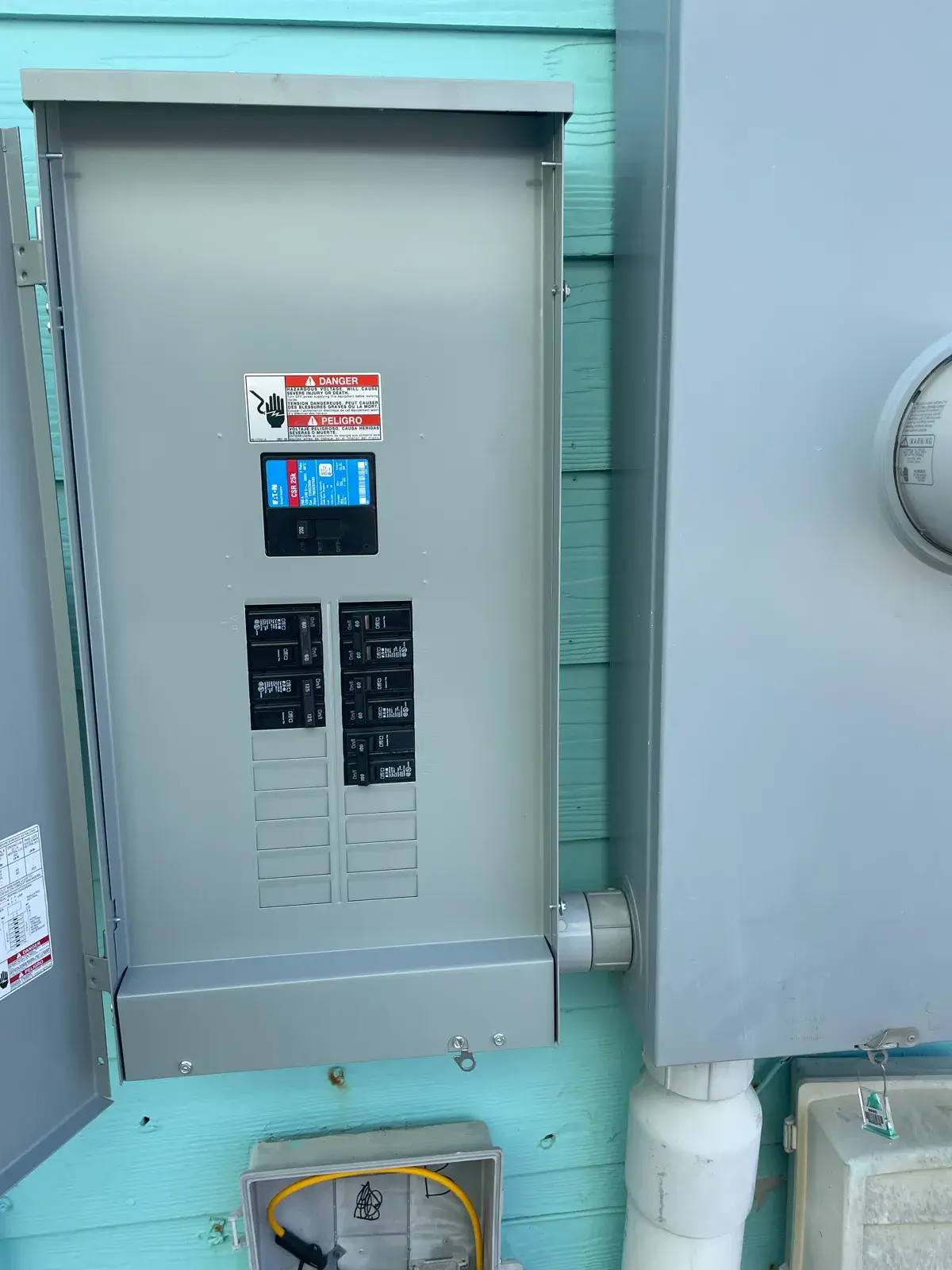
That matters because a typical Level 2 charger pulls 32 to 48 amps continuously and needs a 40 to 60 amp breaker. Whether your existing panel can take that circuit depends on a real load calculation, not on the amp rating printed on the panel door.
The 80% rule, in plain English
The NEC treats EV charging as a continuous load under Article 625. That means the circuit is sized so the charger draws no more than 80% of the breaker’s rating. A 40-amp charger needs a 50-amp breaker on 6 AWG copper. A 48-amp charger needs a 60-amp breaker on 4 AWG copper. That 80% rule is why a “40-amp charger” shows up on the panel schedule as a 50-amp circuit.
Circuit side is only half the math. Panel side is separate. A 100-amp service is not automatically out, and a 200-amp panel is not a free pass.
What a load calc actually looks at
Jimmy walks the house and adds up what already draws power on your service, then compares that total to what the panel is rated for. Central AC and heat strips in an electric furnace or heat pump are usually the biggest single load in a Baldwin County home. An electric range, an electric dryer, and an electric water heater each carry real weight. General lighting and receptacle load is calculated from square footage, so a 3,200-square-foot house on Fish River carries more baseline load than an 1,800-square-foot bungalow in Loxley. Gas appliances subtract wherever they replace an electric equivalent.
Once those numbers are on the sheet, the NEC demand factors reduce the total, since not everything runs at once, and what is left is your available headroom. The charger circuit either fits under that ceiling or it does not.
Two paths. Upgrade the service to 200 amps, a common play on older coastal homes anyway. Or install a load-managed charger, a feature on most current Tesla Wall Connector, Wallbox, ChargePoint, and Enphase units that reads the panel’s total draw and throttles the charger’s output rather than trip the main. NEC 750 recognizes it, and for a home that would otherwise need a full service upgrade, load management can save a real chunk of scope.
For a detached garage or a workshop that already runs long from the main house, a subpanel sometimes ends up simpler than pulling one heavy conductor across the yard. Wave Electric’s EV charger installation service covers the panel work, the circuit, the mount, and the permit as a single job.
Do I need a permit to install an EV charger in Alabama?
Yes. Every incorporated Baldwin County city requires an electrical permit for a new 240-volt circuit, and every utility here wants that permit on file before it approves the added load. Baldwin County itself only permits unincorporated areas plus Elberta, Magnolia Springs, and Perdido Beach, so on a city address the city is who you file with.
| City | Permit authority | Electric utility |
|---|---|---|
| Fairhope | City of Fairhope Building Department | Fairhope Public Utilities |
| Daphne | City of Daphne Building Inspection Department | Riviera Utilities |
| Spanish Fort | City of Spanish Fort Building Department | Riviera Utilities |
| Foley | City of Foley Building Department | Riviera Utilities |
| Gulf Shores | City of Gulf Shores Building Department | Baldwin EMC |
| Orange Beach | City of Orange Beach Building Department | Baldwin EMC |
| Robertsdale | City of Robertsdale Building Department (CloudPermit) | Robertsdale Utilities |
| Bay Minette | City of Bay Minette Planning & Development Services | confirm with the city |
| Loxley | City of Loxley Building Department | Riviera Utilities |
Each city's building department, 2026
A handful of quirks are worth calling out. It varies by city. Foley stopped accepting the general contractor’s board electrical certification in 2010 and will only issue an electrical permit to a state-certified electrical contractor, which means a homeowner cannot pull one for their own charger install there. Daphne requires the structure itself to be permitted before an electrical permit is issued, which usually only matters on new construction. Loxley stacks its reinspection fees fast: the first is free, the second is $50, the third is $100 plus a two-day wait. And Gulf Shores requires every new or upgraded electrical service to be installed underground, inspected in the trench before backfill, so any install that pushes into a service upgrade there triggers that rule.
For the fuller picture on how permits work across the county, we wrote a whole post on who issues your electrical permit in Baldwin County.
Hardwired or plug-in near the coast
For most Baldwin County homes, hardwired is the better call. Along the water, hardwire it.
Hardwiring runs conductors straight from the panel into the charger’s internal terminals, which lets a 48-amp charger use its full continuous output on a 60-amp circuit and takes the receptacle out of the failure chain. A NEMA 14-50 plug-in install is popular because it feels portable. Sell the house or change cars and you unplug the charger and take it with you. It is also capped at 40 amps continuous, because a 14-50 lives on a 50-amp breaker and the 80% rule holds.
Salt is what tips the decision on this coast. Salt air pits the contact surfaces inside a 14-50 receptacle, and a loose or arcing plug on a 40-amp continuous circuit is a live fire hazard, not a theoretical one. If you are in Gulf Shores, Orange Beach, or on the Fairhope bluff, hardwire it. If the charger has to live outside on a carport, use a NEMA 4 or 4X enclosure and mount it under cover if you can. Salt spray on plastic housings is unforgiving over a ten-year service life. Ten years is long.
Inland the calculus loosens. In Loxley, Robertsdale, or Bay Minette, a 14-50 install is fine if you want the flexibility, and Jimmy will spec it that way if that is what you want.
If you’re pairing the charger with solar
Charger-only installs do not touch the utility beyond the load approval. Add solar and it changes. Charger plus solar is a different animal on this side of the Mississippi.
If you are a Baldwin EMC member, generation ties in through a six-step interconnection process the co-op publishes on its solar page:
- Application to Energy Services with generator specifications
- Approval
- Install to Baldwin EMC’s technical requirements
- Notify the co-op of completion
- EMC-coordinated commissioning test
- Sign the interconnection agreement and receive permission to operate
Systems at or above 10 kW trigger a facilities study. Aggregate PPA capacity under 50 kW stays with Baldwin EMC. At 51 kW and up, PowerSouth handles it. Solar members on the time-of-use tariff pay a $46.95 basic service charge, and the member pays all interconnection and system-upgrade costs.
Riviera Utilities publishes a parallel Customer Renewable Generation rider (Schedule RG1), plus its own EV Level II and Level III DC Fast tariffs. If you are in Daphne, Spanish Fort, Foley, or Loxley and pairing solar with charging, those are the sheets to read.
How long does a Level 2 charger install take?
Hours, not days. A typical residential Level 2 install is 2 to 4 hours on site once the permit is in hand. Jobs that need panel work, a subpanel, or a long conduit run through finished walls stretch to a full day, sometimes two.
The work itself is straightforward. Jimmy runs the circuit from the panel to where the charger mounts, terminates both ends, tests the unit, walks you through app setup if the charger has one, and requests the inspection. The inspection is a separate visit from the city, usually within a few business days. Foley averages seven to ten days on the permit application and asks for 24 hours’ notice on the inspection request. Spanish Fort and Daphne tend to schedule faster. Foley does not.
If the panel is full and needs a full panel upgrade, or your service has to go underground because Gulf Shores requires it, the calendar shifts from hours to days. That is not a delay in the charger install. It is a different scope of work, and it gets scheduled with the utility once the permit clears. If your existing panel is already tripping before you add a charger, our post on why a breaker keeps tripping on the Gulf Coast is the one to read first.
Condos, HOAs, and rentals near the beach
Level 2 charging in a Gulf Shores or Orange Beach condo is not the same job as a single-family install. The meter, the panel, and the parking space are usually shared, and adding a charger touches all three.
Start with ownership. In most beachfront buildings, the unit owner owns the panel inside the unit, but the service into the building, the house meter, and the parking structure belong to the association. A charger mounted on a garage post or a covered parking wall almost never runs off your in-unit panel. It runs off a house panel or a dedicated feed the HOA controls, which means the HOA has to approve the install before the city will issue the permit.
HOA approval usually pulls the building’s engineer or property manager into the room. They want to know where the circuit lands, how it is metered so the owner (not the building) pays for the power, and what the plan is when the next three owners want chargers on the same building service. The answer at that point is usually a load-managed setup that shares a fixed amount of capacity across several chargers instead of pulling a full 40 or 50 amps per unit.
For short-term rentals on Fort Morgan Road or in the Perdido Pass buildings, the rules run through both the HOA and the city’s rental permitting, and any exterior work in Gulf Shores hits the underground-service rule if the run has to be extended. Jimmy has done work in condos in Gulf Highlands and near Terry Cove in Orange Beach, so the pattern is familiar. HOA first, permit second, install third, with the building’s engineer looped in on anything that touches the shared service.
If you own a unit and want a charger at your parking space, the first call is your HOA. The second call is a licensed and insured electrician who has run condo work in Baldwin County. Jimmy can scope the install and give the HOA a written proposal to review, which tends to move approval along faster than an owner asking cold.
Notes for 2026
Good news first. Charger stock is more predictable than it was two years back. Tesla Wall Connectors, ChargePoint Home Flex, and Wallbox Pulsar Plus are all in reasonable supply, so you do not have to take whatever is on the shelf.
Utility interconnection times shift with the season on this coast. If your install triggers a service upgrade, plan around hurricane season. In September and October the utilities usually run heavy on storm work, which pushes new meter sets down the queue.
If your existing panel is a Federal Pacific Stab-Lok, a Zinsco, or a coastal service that is already showing corrosion at the meter base, do not hang a 40-amp continuous load on it. The charger job becomes a panel replacement first, and Jimmy will tell you that on the quote rather than mid-install.
Call Jimmy
If you are planning an EV charger install anywhere in Baldwin County, call Jimmy at 251-656-4601. He comes out, runs the load calculation, tells you whether your panel is ready or needs work, pulls the permit for your city, and sets up the inspection. Estimates are free. Wave Electric is licensed and insured, and Jimmy has done this install from your home to your business across all nine cities we cover.