A breaker that keeps tripping is doing its job. It is not the problem. Something on that circuit is drawing more current than the wire is rated for, there is a fault, or the breaker itself has aged out. On the Gulf Coast, three suspects turn up over and over: an AC compressor pulling hard on a 95-degree afternoon, a builder-grade breaker that gave up early, and humidity sneaking into a GFCI.
The right response is not another reset. It is figuring out which of a handful of causes is at work, then fixing that thing. That is what troubleshooting and repairs work looks like at Wave Electric.
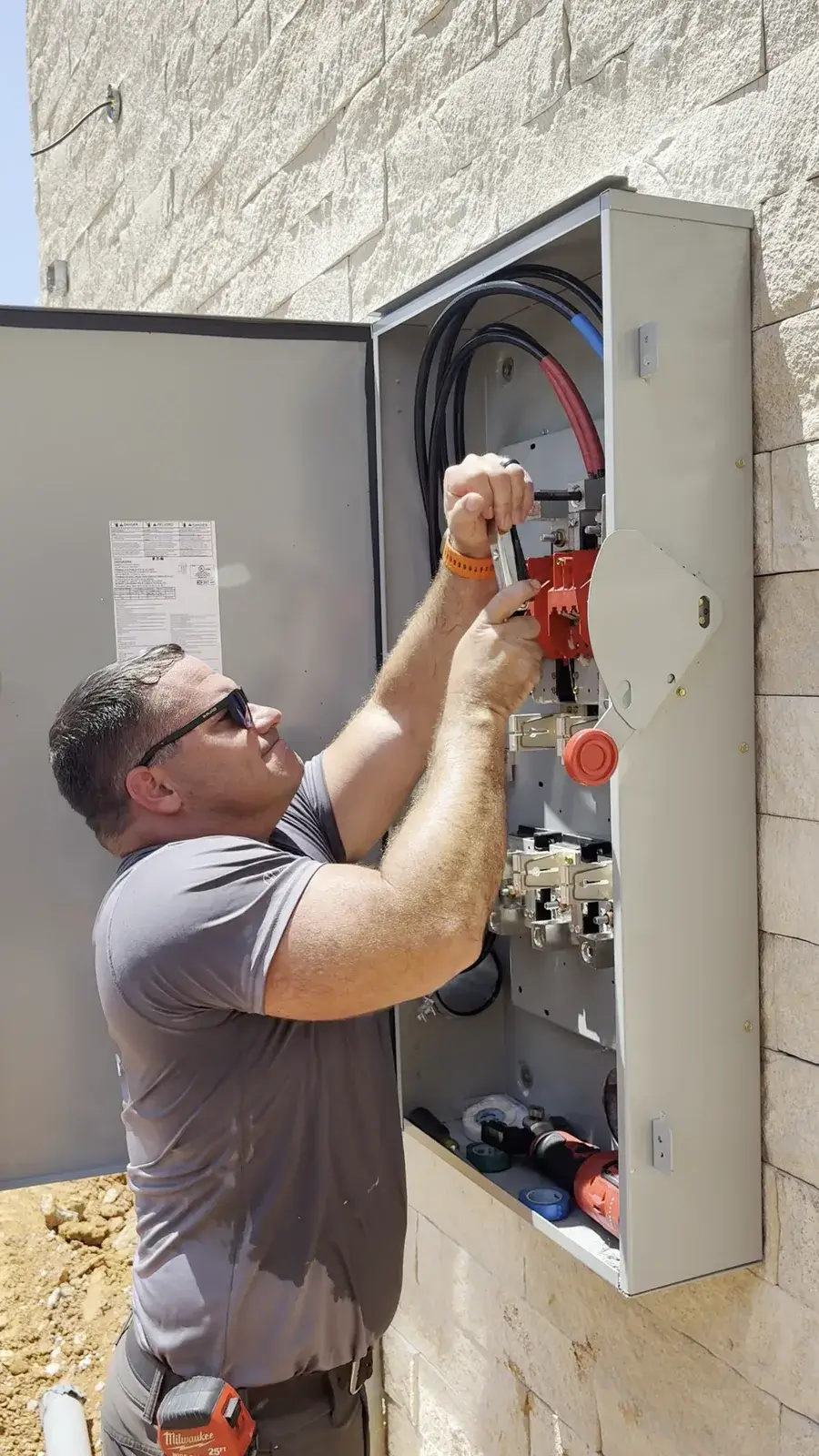
- Main breaker. Cuts everything downstream. Warm here is never normal.
- Bus bar. Where a hidden loose connection heats a whole column of breakers.
- Individual breaker. The one that trips. Sometimes just tired.
- Breaker lugs. Torque here matters. Loose = heat = false trips.
- Neutral bar. A loose neutral is the classic cause of a ghost trip.
Why your breaker trips when the AC kicks on
An AC compressor pulls a burst of current at start-up that runs five to seven times its steady load. A healthy breaker shrugs that off. A tired breaker, or a weak start capacitor, does not.
The mechanics matter. Central air uses an induction motor. Before it is spinning, it draws what the nameplate calls locked rotor amps, or LRA. A 3-ton system that runs at 15 amps can pull 60 to 90 amps for a fraction of a second at start. Residential breaker trip curves are designed for exactly that transient.
Two things push a healthy system past the curve. The start capacitor weakens with age, stretching the inrush window from a fraction of a second into something the breaker’s thermal element notices. A hard start kit or a new capacitor usually solves that. Second, the breaker itself has quietly calibrated its way down after summers in a hot outdoor panel. That one is a Jimmy call, not an HVAC call.
If your breaker trips every afternoon in August but holds in the morning, it is one of those two. Both are worth catching before the compressor does. A compressor that keeps trying to start against a weak cap draws hard, heats up, and eventually locks up for good, which is a much bigger bill than a start kit.
Loose lugs at the breaker or the outdoor disconnect can cause the same trip for a different reason: heat. Heat at a bad connection raises the local temperature of the breaker, which lowers the current it takes to trip it. Torque and thermal imaging on the panel and disconnect catch it. That is standard on any AC-related trip call.
Why does a newer house in Foley or Fairhope keep tripping breakers?
Because a lot of newer subdivisions across south Baldwin got builder-grade panels stocked with the cheapest breaker the spec allowed, and those breakers wear out in a few years. Foley and Fairhope both see the pattern often enough that it lives on the Foley and Fairhope service area pages.
Two failure modes show up. A single breaker starts nuisance-tripping on a circuit that is not overloaded. That points at the breaker itself losing calibration. Or several breakers on the same panel start acting up over a season, which points at heat, a loose bus connection, or a panel brand with a known history of underperforming. Swap the weak parts for something coastal-grade and the house usually settles down.
There is also the “nothing is plugged in and it still trips” version of the call. Ghost trips almost always trace to one of three things: a failing breaker, a loose neutral or hot inside a box on that circuit, or a marginal short in a wire run that only pulls current under certain conditions. A meter finds it. Swapping breakers until it stops does not.
Humidity, salt air, and the 5-milliamp GFCI threshold
Coastal humidity and salt air raise leakage current on outdoor and bathroom circuits. Cross about 5 milliamps of leakage and a GFCI trips, because a GFCI is looking for a mismatch of just a few milliamps between hot and neutral. That is the device doing its job.
GFCI protection is required by NEC 210.8 in kitchens, baths, garages, outdoors and near pools and docks. Salt residue on an outdoor outlet face. Moisture creeping into a screen porch box. A bathroom outlet on a wall that shares humidity with the shower. Any of those can push leakage over the threshold on a muggy morning, and nothing has to be plugged in.
Fixes depend on where the trip is. Outdoor and porch outlets that trip after every rain often need an in-use cover, a gasketed box, or a proper weather-resistant device rated for the environment. Bathroom GFCIs that trip in humid weather sometimes just need a newer device with better tolerance. The corroded ones need to come out.
Arc-fault breakers, or AFCIs, are the other side of this coin in bedrooms and living areas. They read the signature of an arc rather than a leakage current. Older AFCIs are notorious for false trips off a vacuum motor. If a specific AFCI trips at the same moment every time, that is a clue, not a mystery.
If you’re bayfront or on the beach, salt air on the meter base and outdoor gear is its own story. Our post on what the Gulf does to your electrical service covers it.
A breaker that resets fine is still telling you something
A breaker doesn’t trip for no reason. One that keeps tripping and resetting is telling you something is wearing on the circuit, and ignoring it lets a small issue turn into a big one.
Three patterns are worth taking seriously even when the breaker resets cleanly. A breaker that trips at the same time each day is almost always tied to a load cycle: AC, well pump, pool pump. A breaker that trips only under certain weather is almost always moisture or thermal. A breaker that used to be reliable and started tripping recently is telling you something on that circuit changed.
Repeated resets stress the mechanism. Every trip works the internals, and a marginal breaker gets closer to failure with each cycle.
The scenario you don’t want is the one where the breaker eventually stops tripping when it should.
Try this before you call
If the breaker holds for a second and drops out again, stop. That is a hard fault on the circuit, and forcing it can damage the bus.
When a tripping breaker is an emergency
Heat at a breaker terminal or on the bus bar means resistance where there shouldn’t be any, and temperature climbs from there. Loose connections in a panel are how residential fires start. Daphne shows up on our schedule often for this reason. The city’s housing runs older than Fairhope’s, and troubleshooting outnumbers new installs most weeks. The Daphne service area page has more on why.
A breaker that refuses to reset, or resets for a second and drops out again, is telling you there is a hard fault on the circuit. That is a short, a ground fault, or a failed breaker. Do not keep trying it. Repeated force-resets on a faulted circuit is the exact scenario a breaker was designed to prevent, and forcing it can damage the panel bus or ignite a wall you cannot see.
Across newer south Baldwin subdivisions, the fix is usually a targeted breaker replacement inside an otherwise healthy panel. Sometimes it is the panel. Jimmy will tell you which.
Call Jimmy for a tripping breaker in Baldwin County
If a breaker in your Foley, Fairhope, Daphne or anywhere-in-Baldwin-County home keeps tripping, don’t keep resetting it. Call Jimmy at 251-656-4601. Wave Electric is licensed and insured, estimates are free, and if the answer is a single tired breaker in an otherwise good panel, that is what he will tell you. After-hours calls are dispatched at emergency rates. From your home to your business, done right the first time.