Salt vapor is a metal-eater. Off the Gulf, an outdoor meter base and panel that would last forty years in Birmingham often quits at year twelve on the coast. You will not see it coming from the sidewalk.
That is the whole reason we keep coming back to the same houses in Gulf Shores and Orange Beach for the same job.
The climate does the work
Fairhope sits an hour inland from open Gulf. Even here, NOAA logs almost six feet of rain a year at the Fairhope 2 NE station. The same station records 81 days a year at or above 90F. Add sea-breeze salt riding that humidity onto the immediate coast and you have a chemistry problem attached to the outside of the house. The chemistry is not subtle.
There is no published salt-corrosivity rating for the Alabama coast. Fine. What we have is what Jimmy sees every week. An enclosure looks fine from the driveway, then the deadfront comes off and there is white powder on every aluminum lug.
Where the corrosion actually starts
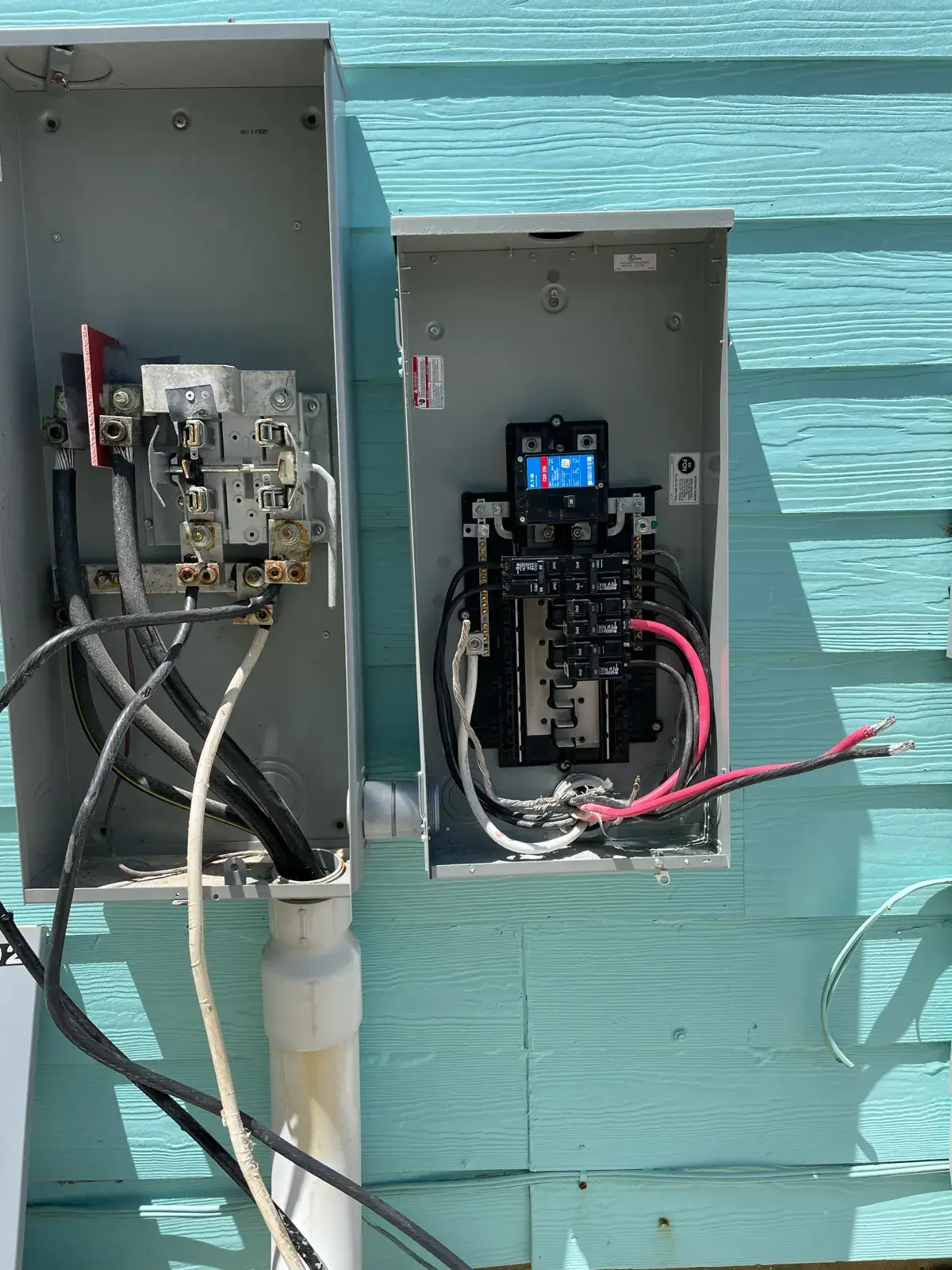
- Service disconnect lugs. The rust you can see here started as salt vapor condensing on cool metal. Corroded lugs lose clamping tension, heat under load, and eventually drop a leg of your 240V service.
- Conduit nipple between the enclosures. Unsealed penetrations are the highway. Humid air rides in, condenses inside, and never really leaves.
- Breaker stabs. Contact surfaces pit where the breaker clips onto the bus. The breaker starts to feel notchy, and one day it does not trip when it should.
- Neutral and ground terminations. Screws seize and aluminum blooms with white powder. A large share of our diagnostic calls on this coast end up right here.
Notice what the door is telling you. Almost nothing. Streaks on the outside are the last stage of a failure that started at the connections behind the deadfront. By the time they show up, those connections have been degrading for years.
The tells inside the house
Corrosion at the service shows up as your furniture acting oddly. Lights that dim when the AC kicks. A microwave that browns unevenly. A bedroom that loses half its outlets at night and comes back by morning.
Half the house behaving differently from the other half is the classic loose or lost service leg. The panel reads fine at rest and stays sick. Put a real load on it and one leg sags. Any of that on a Fort Morgan Road beach house or a Bon Secour cottage is a “have it looked at” item, not a “watch it another season” item.
Who owns the meter base, you or the utility?
You do, through a licensed electrician. The utility owns the service wire and the meter itself. Everything from the meter socket in is yours to maintain, repair, and replace.
That is why a lineworker who flags a rusted-through meter base pulls the meter and drives off. Nothing to reconnect. From there, a licensed electrician replaces the base (and the panel if it earned that too), a city inspector signs off, and the utility comes back to reset. Jimmy has done that dance enough times to plan the outage window around the utility instead of guessing at it. It is a scheduled outage, not a surprise.
Underground rules and the Gulf Shores twist
The City of Gulf Shores requires every new and upgraded electrical service to be installed underground. The building department inspects the trench and conduit before backfill. If your existing service is overhead, budget the trench, PVC conduit, and the underground routing into the same job as the electrical.
Orange Beach does not blanket-require underground. It runs trade permits through an online Permit Portal, and a service replacement gets filed there. Bayfront Fairhope homes on Scenic 98, or up in Battles Wharf and Point Clear, get plenty of salt exposure too. Fairhope owns its utility, so the entire loop stays inside city hall on South Section Street.
What a coastal spec buys you in years
NEMA 3R is the floor for outdoor gear. On the immediate coast we start there and add tinned copper where we can, stainless mounting hardware, anti-oxidant compound on every aluminum termination, torque-wrench-checked lugs, and hubs sealed correctly at the top of the meter can so water cannot walk down the mast into the socket.
None of that is exotic. It is the bill of materials on a job done once instead of twice. Plain-steel screws in a Gulf Shores meter base are seized and weeping rust in five seasons, and the honest replacement cycle drops from fifteen years to eight.
There is one other choice that matters here. Panel brand. We spec Eaton and Square D on coastal work because their outdoor product lines and their availability at the local supply houses are both what they need to be. If your current panel is a Federal Pacific Stab-Lok, a Zinsco, or a Pushmatic, corrosion is not the biggest problem inside that enclosure.
How often a coastal panel should be looked at
Every three to five years for anything within a couple of miles of the water, and any time after a named storm. An electrical safety inspection on a coastal home is a real inspection, not a walkthrough. Jimmy pulls the deadfront, checks the buss and lugs for heat marks and corrosion, tests GFCI protection where code requires it, and looks at grounding at the water line and the driven ground rods, which fail early in sandy Gulf Coast soil.
For an out-of-state owner running a rental on the Peninsula or a condo on Ono Island, tie the inspection to a date you already remember. Insurance carriers across Alabama have been asking about the meter base on coastal properties at the 2026 renewal season. A documented recent inspection is a much shorter conversation than an active fuse panel is.
For a full-time home, tie it to hurricane-season prep. Our hurricane season checklist is the sibling piece.
This year’s notes
Coastal jobs are landing in the same order they have for years. Meter base first. Panel second. Grounding cleanup third. Coastal-rated gear is on the shelf at the Baldwin County supply houses, 200-amp Eaton panels are in reasonable lead times, and the utilities continue to hold the same line on reconnection. Nothing has softened there. It will not.
Ready to have it looked at
If your outdoor gear looks tired, or a Baldwin EMC lineworker has already flagged it, do not wait for the meter to come off. Call Jimmy at 251-656-4601 for a free estimate.
Wave Electric is licensed and insured, works Baldwin County only, and gets coastal service work done right the first time.