The panel is where an older Eastern Shore house wins or loses your insurance policy. Have a licensed electrician open it before you sign, and you already know whether the house is a fix or a walk-away.
Older homes here run the full range. Turn-of-the-century cottages off Section Street. Mid-century ranches in Lake Forest. 1970s and 80s builds all through the Eastern Shore and around Spanish Fort Town Center. Any of them can be a great house. Some of them have wiring or panels that will cost you an insurance policy, or start a fire, if nobody looks before you close.
One in three Bay Minette homes was built before 1970
Baldwin County looks new on paper, with a median home built in 1999. That number hides the risk. Pull the same census table by city and the map splits sharply, from beach condos built this century to Bay Minette streets full of pre-1970 stock.
Fairhope is the tension in that chart. The city’s median year built is 1998, so on a spec sheet it reads as a new-home town. Dig into the same census table and you find about 1,625 Fairhope homes still date to before 1970. Medians hide old houses. A subdivision boom drops thousands of new roofs next to a few thousand old ones, and the middle year lands somewhere neither number describes.
The pre-1970 cottage you’re touring off Section Street or in Battles Wharf is invisible in that 1998 median. It is also the house your carrier is going to ask about.
Federal Pacific and Zinsco panels haven’t earned another decade
Two panel brands come up in almost every older-home call: Federal Pacific Stab-Lok and Zinsco. Both have a documented history of breakers that fail to trip on overload or short circuit. That is the one job a breaker exists to do. When it doesn’t, the wiring downstream keeps heating until the insulation fails, and that is how a fire starts in a wall you can’t see.
You’ll still see both brands throughout the older housing stock, and the fix is not new breakers in the old box. It’s a full panel upgrade, usually a one-day job on a typical Eastern Shore house. If the seller already replaced the panel, ask for the permit number and the inspection sign-off. A new door does not prove new bones.
What is a 4-point inspection, and why does your insurer want one?
A 4-point inspection is a short report on four systems (roof, HVAC, plumbing, electrical) that Alabama carriers require before writing or renewing a policy on an older home. Electrical is the section that most often kills the deal. It is also the system most likely to burn the house down.
For the electrical portion, the inspector documents panel age and brand, service amperage, branch wiring type, and whether grounding meets current code. Federal Pacific, Zinsco, knob and tube, or a 60-amp fuse box means repairs before the carrier binds coverage. A general home inspector can flag concerns. Many Alabama carriers now want the electrical section signed by a licensed electrician on his own letterhead, which is what an electrical safety inspection from Wave Electric produces.
Aluminum wiring and why coastal terminations fail first
Aluminum branch wiring went into Alabama homes from roughly 1965 to 1973. The wire itself is fine. The trouble is at every connection: outlets, switches, breaker lugs. Aluminum expands and contracts more than copper on every load cycle, and over decades the terminations loosen, oxidize and heat.
On the coast that clock runs faster. Salt humidity keeps splices damp. A Point Clear cottage running aluminum in 1972 has had fifty summers of that. An inland ranch in Loxley has had the same wire but drier air, and it is usually a decade behind on failure.
You have two real fixes. A full copper rewire is permanent, and it is what most carriers want documented on an older Fairhope or Daphne file. A targeted AlumiConn or COPALUM retrofit converts every termination to copper without opening every wall, which can be the right call on a smaller budget or in a house you plan to sell within a few years. Doing nothing is not on the list. The whole-home rewiring page walks through both.
Knob and tube is a shorter conversation
Knob and tube is mostly in Baldwin County houses built before World War II. The fabric or rubber insulation goes brittle. The runs were never designed for a modern kitchen. Most Alabama carriers will not write a policy on an active knob-and-tube circuit, so if the report names it, plan on rewiring the live runs before you close and factor the cost into your offer. A lot of it has been abandoned in place over the years, and Jimmy scopes only what is still live.
Two-prong outlets and the ground you don’t have
Older Baldwin County homes with two-wire cable have no ground path back to the panel. Swap a two-prong outlet for a three-prong on that circuit and you have created a code violation, and the symbol on the face of the outlet is now a lie. Your surge protector believes there is a ground.
There isn’t.
Three paths are legitimate:
- Run a new grounded circuit from the panel to that outlet. Right answer in kitchens, baths, garages, laundry rooms and anywhere sensitive electronics live.
- Replace the two-prong with a GFCI. Code-compliant on an ungrounded circuit and protects against shock, though a plug-in surge protector still has nowhere to shunt a spike.
- Leave the two-prong alone in a bedroom or a barely-used room. That is a defensible call in an older house.
Walk it with Jimmy, mark which outlets matter first, and put a written number on the priority ones before any work starts. If breakers have been tripping during your walk-throughs, our post on why your breaker keeps tripping on the Gulf Coast covers the usual suspects.
What Jimmy checks in the panel before you close
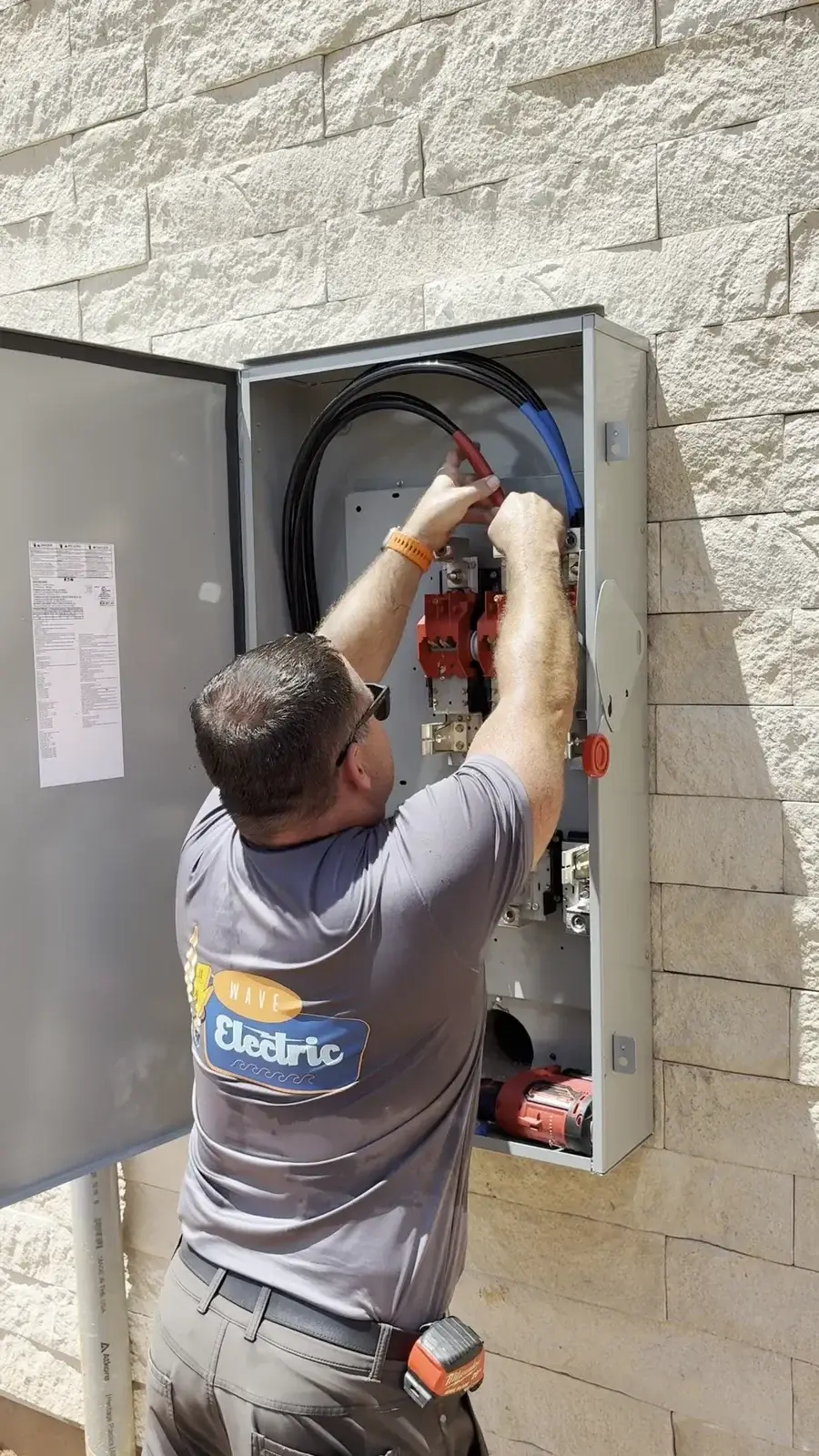
Open the door and start at the top. Main breaker rating. Bus condition. Any sign of heat discoloration on the plastic near a breaker. Double-tapped lugs where two conductors share a screw. Undersized neutrals. Missing labels. The brand and the year.
From there, GFCI and AFCI protection in the kitchens, baths, garage and exterior outlets. Code requires it in those rooms, and those are the rooms a 1970s house never had it in. Grounding at the water and gas lines and the service entrance gets tested next. Then the meter base itself. Salt air pits the enclosure and corrodes the lugs inside long before you’d notice from the yard. If the house has aluminum, Jimmy pulls a handful of terminations and looks for the bronze-black film that says the connection has been running warm.
Most inspections take one to two hours. You leave with a written report, photos and a prioritized punch list: safety, code, wait. If work needs doing, you get a quote on the same items so you’re not chasing a second opinion during the option period.
As of the 2026 renewal season, several Alabama carriers are also asking about the meter base on coastal properties, especially the closer the house sits to the bay in Fairhope and Point Clear.
Salt air pits enclosures. What is inside the box is often worse.
Our post on salt air, panels, and meter bases covers what to look for.
Permits move at different speeds in every city
If work needs doing before you close, Jimmy pulls the permit with the right city building department, coordinates with Riviera Utilities or Fairhope Public Utilities on any meter work, and gets the inspector out. Each Eastern Shore city runs its own pace. Foley wants seven to ten days to process and 24 hours’ notice for inspection. Fairhope requires a City business license in addition to the state electrical license. Daphne insists the structure itself is permitted before an electrical permit can issue.
That is context worth having before your option period tightens. See our Fairhope service area page, Daphne service area page and Spanish Fort service area page for local permit contacts and inspection windows.
Call Jimmy before you sign
Under contract on an older home in Fairhope, Daphne or Spanish Fort and the general inspector wrote “have an electrician evaluate”? Don’t wait until the option period is closing. Call Jimmy at 251-656-4601 or send the contact form. Wave Electric is licensed and insured, estimates are free, and Jimmy will tell you straight whether the house is a fix or a walk-away.